
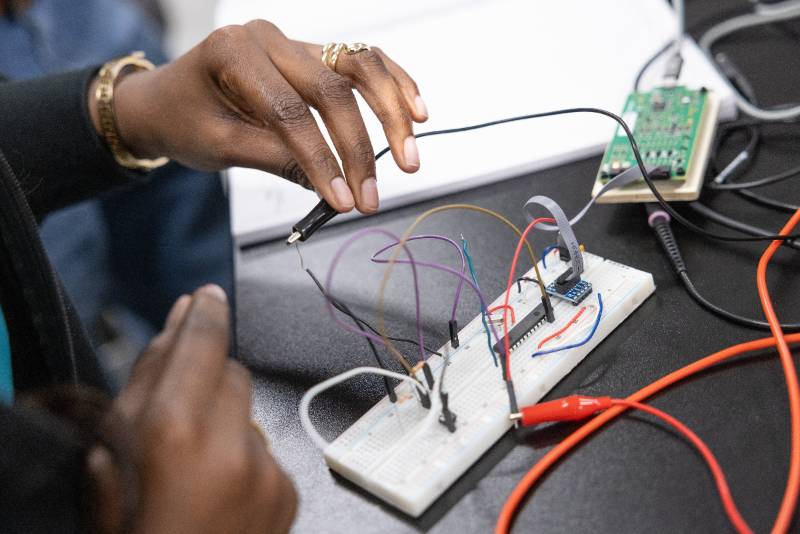
National Science Foundation award supports STEM innovation at Lawson State and other
HBCCs
Lawson State Community College, Drake State Community and Technical College and Trenholm
State Community College have been awarded a $500,000 National Science Foundation (NSF)
grant for Semiconductor Exposure, Exploration, and Development (SEED): A Collaborative
to Broaden Participation in STEM Education.
The grant award period runs from October 1, 2026, through September 30, 2029.
This landmark award highlights the collective strength of three of Alabama's Historically
Black Community Colleges as they work together to identify innovative strategies that
expand access to STEM education and prepare students for emerging opportunities in
the semiconductor and advanced technology sectors.
"Lawson State is proud to be part of this transformative partnership that expands access to high-quality STEM education and prepares our students for careers in one of the nation's most critical and rapidly growing industries," said Dr. Cynthia T. Anthony, President of Lawson State Community College.
"Through the HBCU CHIPS Network and the SEED initiative, we are creating new pathways for students to gain the skills, exposure, and industry connections needed to succeed in semiconductor and advanced technology careers," Dr. Anthony said. "This investment strengthens not only our institution, but also the economic vitality and workforce potential of the communities we serve."
About the collaborative
The partnership will help Lawson State, Drake State and Trenholm State retrain, retool, and upskill instructors in the semiconductor ecosystem.
"We plan to do this through professional development opportunities, and exposure and exploration in the industry," said Dr. Bruce Crawford, vice president for instruction at Lawson State. "Collaboratively, our colleges will work with the semiconductor industry to identify teaching, learning, and training opportunities for faculty and to develop technical workforce training based upon semiconductor industry needs."
In addition, the SEED Collaborative aims to create new pathways for student engagement,
exploration, and career development in science, technology, engineering, and mathematics
(STEM)---all while strengthening institutional capacity to support workforce needs
in one of the nation's fastest-growing industries: advanced manufacturing.
This NSF investment also recognizes the applied sciences as a vital connector across
traditional STEM disciplines, strengthening both workforce preparation and scientific
discovery by fostering interdisciplinary approaches that translate theory into innovation
within the semiconductor and advanced technology sectors. There are more than 360,000
related jobs in the U.S. today, but upward of 115,000 additional workers are needed
by 2030, according to the Semiconductor Industry Association's 2026 annual report.
"This award reflects a shared commitment among our institutions to broaden participation
in STEM education and create transformative opportunities for students," said Dr. Patricia Sims, President of Drake State Community & Technical College. "Through collaboration, innovation, and a focus on student success, we are positioning
our students to thrive in the high-demand careers that will shape the future economy."
An exceptionally strong partnership
Dr. Kemba Chambers, President of Trenholm State Community College, said, “This grant represents an extraordinary opportunity to connect our students to the future of innovation and advanced manufacturing. By collaborating with fellow Historically Black Community Colleges, we are broadening participation in STEM fields and ensuring that talented students from our communities have access to emerging opportunities in the semiconductor industry."
"Together, we are building a stronger, more diverse workforce that will help drive
technological advancement and economic growth throughout our region and beyond," Dr.
Chambers added.
Project aims to strengthen STEM pathways
Dr. George White, Executive Director of Strategic Partnerships at the Georgia Institute
of Technology, and co-founder of the HBCU Chips Network, is also supporting the project. Dr. White's expertise and leadership will help guide
the collaborative's efforts to strengthen pathways into semiconductor careers and
foster greater participation in STEM disciplines among underrepresented students.
The NSF-funded project comes at a pivotal time as industry, government, and educational
institutions work to build a robust domestic semiconductor workforce. In Alabama,
for example, institutions like Alabama A&M and University of South Alabama also have
significant programs focused on microelectronics and the semiconductor supply chain---especially
as it relates to aerospace and defense technologies.
The timing for the SEED initiative, which will ultimately enhance career readiness for future technology leaders, comes as national efforts are underway to bolster the advanced electronics workforce. That includes Alabama's role in ensuring public and private sector employers have access to workers with the right kind of industry-aligned training.
For more information, contact Dr. Bruce Crawford, Lawson State Vice President for Instruction.